
The self-reflection tool has been developed for professionals working in any field of human services who want to improve their practice in working with older women who have experienced gender-based violence (GBV) through the integration of trauma-and violence- informed principles. It can also be used to open discussion among staff in an organization about how to create a positive and safe environment for older women. The self-reflection tool can be integrated into an organization’s ongoing quality improvement process.
Complete our 10 question self-assessment tool and then explore how these relate to the TVI principles and deepen your understanding and practice.
The next section explores the 10 questions in relation to the TVI principles with further information and to offer examples and ways to think about how you can deepen your understanding and your practice. The examples are offered simply as examples to help you think about your responses and what the principles mean to you. The questions have been grouped with applicable principles.
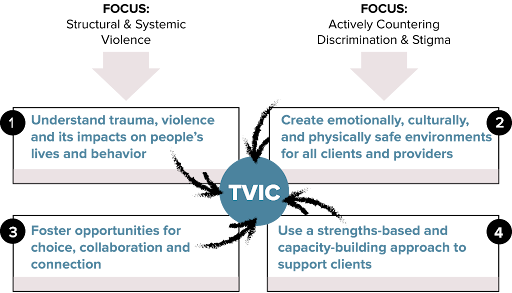
Trauma -and violence-informed principles recognize the connections between violence, trauma, outcomes and behaviours. Applying the principles can help create mutuality and genuine connection, both of which are fundamental to developing cultural safety and humility.
© Nadine Wathen, used with permission
P1: Understand trauma and violence, especially structural and systemic violence, and the impacts on people’s lives and behaviours.
Adding “violence” to being trauma-informed expands our understanding of the causes of trauma from strictly individual experiences, to include the impacts of structural violence, social inequities and discrimination as root causes. This first principle is foundational because it grounds all other TVI practices in an awareness that people’s struggles are not only personal but also shaped by systemic conditions.
For example, sexism has lifelong economic consequences for women. Although sex is recognized as a protected human right, women experience economic sexism across the lifespan. The gender-wage gap means that women earn less. This disparity can determine whether an older woman will be able to live independently or will be forced into poverty. Financial dependency is a known risk factor for gender-based violence. The wage gap is not an individual shortcoming but an expression of structural violence, harm produced by the very systems and institutions that organize society. As a result, women are disproportionately likely to live in poverty as they age, making them more vulnerable to harm and exploitation.
As you reflect on your practice, hold P1 in your awareness. Consider: how has your training, your organization, the community and society shaped and informed your practice?
The status quo in many human service settings can be institutional and sterile. It takes effort and creativity to overcome the first impressions of an unwelcoming physical space.
Make conscious choices to create warmth and welcome. Becoming aware of your specific actions will help you be more intentional and thoughtful about the steps you take to create the conditions for an exceptional service experience. This can be especially useful with someone you may initially struggle with or have judgement about. Genuine interest and curiosity about the person is a good start to creating safety.
Tip: Learn more about creating a welcoming environment.
See: Equip Health Care: equity-walk through
Applicable TVI Principle
Principle 2: Create cultural safety in emotionally and physically safe environments
Making judgments is human. First impressions that are harsh are not uncommon. What matters is being able to recognize your response as a judgment so that you can take steps to shift toward seeing this (and every) person with humility. Shifting to see the person will help you provide the same level of care and support for everyone.
Tip: Instead of asking why a person is ‘like that’, change your question to “I wonder what has happened to this person?”
Watch Dr. Colleen Varcoe talk about how and why to shift your practice to TVIC
Applicable TVI Principle
Principle 1: Understand trauma and violence, and their impacts on peoples' lives and behaviours environments.
The business model values of human services can feel like moving people along an assembly line of services. Professionals are often encouraged to focus on the presenting situation or symptom and not take the time to explore context or history.
The issue of time is at the heart of the transformation that is being called for. You can hear it in language such as, ‘person-centred’ or ‘holistic’. However, it is contradiction to suggest that anyone can be person-centred if the schedule strictly dictates the interaction. Think about it.
We all have to work within the constraints of the existing system. If there is no possible way to increase time or to be flexible with time with people you serve, then find other ways to connect. Meaningful, genuine connection can be a powerful ally and can happen in a moment.
Read: Reclaiming Power and Place: The call for a new framework (pgs. 89-101)
Applicable TVI Principle
Principle 2: Create cultural safety in emotionally and physically safe environments
If you feel this way, it’s not without reason. Assuming you “know better” reflects a traditional power dynamic in human services, where professionals are seen as experts, and service users are expected to follow their guidance. This mindset can undermine trust, limit meaningful connection, and obscure the person’s lived expertise.
Principle 2. To practice cultural safety, it’s essential to recognize and actively work to soften these power imbalances. Seeing this person as a full human being, not a case to manage, creates space for dignity, autonomy, and mutual respect.
Victim-survivors have been called context experts in the sense that each person is the expert in their own life. The context is their story. Listening will allow your professional acumen to be used most effectively. Professional expertise is in service to context expertise.
Principle 3. What seems like a reasonable option or choice to you may not be realistic or safe for the other person based on their lived realities. Take care not to project your values or assumptions onto their decisions. By fostering choice, collaboration, and connection, professionals can shift from “fixing” to walking alongside. Curiosity, humility, and open-ended questions help ensure that decisions are shaped by the person’s context, not professional or personal assumptions.
Principle 4. A strengths-based approach begins by listening carefully for how a person is already making strategic, often courageous decisions to stay safe within their constraints. Reflect back to the person what you see and hear to show you are listening and honouring what the person is sharing. Not word-for-word, but more to offer back the heart of what is said. This can also help a person hear their own truth more clearly.
A core part of shifting toward trauma- and violence-informed, rights-based, and relational work occurs when a service provider sees this person as a whole person navigating complex realities. The shift begins to unravel the traditional hierarchy embedded in most service systems. It becomes possible to:
Even when time is limited or systems are rigid, small shifts in how we hold power, connect, build trust, and reflect back our respect can transform the service experience.
Applicable TVI Principles
Principle 2: Create cultural safety in emotionally and physically safe environments
Principle 3: Foster opportunities for choice, collaboration, and connection
Principle 4: Provide a strengths-based and capacity building approach to support client coping and resilience.
The status quo in many human service settings has been described as ‘one size fits all’, programmatic and/or siloed. You probably do things that make the system work for the people you serve or work alongside. You might think of it as a ‘work around’ or bending the rules. You might think they are small actions of little consequence. Instead of thinking about them as unusual, think about them as a new normal, using your skills and abilities in a trauma -and violence- informed way. With TVIC, the exception is the rule because every person is unique.
Applicable TVI Principles
Principle 3: Foster opportunities for choice, collaboration, and connection
Principle 4: Provide a strengths-based and capacity building approach to support client coping and resilience.
Listening helps to create safety because it conveys your understanding that ‘context is everything’ for you to be able to provide the best possible service that is tailored to the person. With careful listening, you convey that the person and their story is important to you.
Tip: Learn about mindfulness as a strategy to become more present with yourself and others:
Applicable TVI Principle
Principle 2: Create cultural safety in emotionally and physically safe environments
Listen to how a person takes steps to keep themselves safe. This reflects your respect and genuine desire to learn about this person and their specific situation. Look for the choices they have made that show strength, endurance and creativity. Validate them.
This will provide a foundation to build upon.
Applicable TVI Principle
Principle 4: Provide a strengths-based and capacity building approach to support client coping and resilience.
Given the prevalence of GBV, every professional should have knowledge of it, no matter the sector. This is because individuals can come through any service door for reasons that may not appear to be related to GBV, and yet GBV is present in their lives and may be directly related to the presenting issue.
Resources: EQUIP Health Care has many resources to support individuals and their organizations in developing equity-oriented care: https://equiphealthcare.ca
Applicable TVI Principles
Principle 1: Understand trauma and violence, and their impacts on peoples' lives and behaviours environments.
Principle 2: Create cultural safety in emotionally and physically safe environments
CNPEA builds awareness, support and capacity for a coordinated pan-Canadian approach to the prevention of elder abuse and neglect. We promote the rights of older adults through knowledge mobilization, collaboration, policy reform and education.
The Wildflower Project is a 5-year initiative led by CNPEA and informed by a diverse group of partners across many sectors including shelters, interval and transition housing, violence against women, elder abuse, and community support services for older adults.
Learn more about CNPEA